Google Flow vs Hyperdream: Which for a Multi-Scene Film?
Google Flow has Google's own models and 50 free credits a day. This Google Flow alternative adds a script, cast sheets, a storyboard and team controls.
By Divy Brahmbhatt9 min read

Pick Google Flow if you want Google's own video models first-hand, 50 free credits a day, and you are happy to plan the film yourself. Pick Hyperdream if you want the film planned as a script, a cast, a storyboard and an edit in one project, or if a team makes films for clients. Both were checked on 10 November 2026. We did not test Flow's output.
Key takeaways
- Models: Flow runs Google's own, including Veo. Hyperdream has ten video models from seven makers, one of them Google's Gemini Omni 1.2, and no Veo.
- Free: Flow gives 50 credits a day. Hyperdream gives 20 credits once.
- Planning: Flow has an Agent and Scenebuilder. Hyperdream's Director has eight steps from Script to Edit, on the $99 Pro plan.
- Teams: Hyperdream's Team plan (2 to 9 seats, from $59 a seat) has roles, client folders and per-client budgets. We found none of these in Flow's help pages.
- Unused credits: Flow's do not roll over. Hyperdream's plan credits last 2 months.
What is Google Flow?
Google's help centre calls Flow "our AI filmmaking tool" for making "cinematic clips, scenes, and stories with consistency" (Get started with Google Flow). It launched in May 2025 as the successor to a Google Labs experiment.
What its help pages list today:
- Google's own models. The models page names Omni Flash 1.2 and Veo 3.1 Lite for video, and Nano Banana models for images.
- Ingredients. Reference images for a character, an object or a place, added to a clip to guide it.
- Frames. A start frame and an end frame for a clip.
- Scenebuilder. It arranges clips in a sequence, reorders and trims them, previews the whole and downloads the scene.
- An Agent. A chat that Google calls "a built-in creative collaborator". It can "outline storyboards", build mood boards, write prompts, and generate images and video in batches. It asks before it spends credits.
When we asked ChatGPT on 10 November 2026 for the best AI filmmaking platform, Flow was in its answer and Hyperdream was not.
How do Flow and Hyperdream compare side by side?
| Google Flow | Hyperdream | |
|---|---|---|
| Video models | Google's own: Omni and Veo | Ten from seven makers. One is Google's Gemini Omni 1.2 |
| Image models | Nano Banana family | Seven, including Nano Banana 2.1 and Nano Banana Pro |
| Planning a film | An Agent chat that can outline a storyboard. No script step found | Director: Script, Look, Cast, Places, Storyboard, Sound, Shots, Edit |
| Keeping a character | Ingredients: reference images added to a clip | One reference sheet per character, place and product |
| Putting scenes together | Scenebuilder: order, trim, preview, download | Edit: a timeline with seven tracks. One MP4 at up to 1080p |
| Free | 50 credits a day | 20 credits, once |
| Paid | Inside Google AI Plus, Pro and Ultra: 200, 1,000, 10,000 or 25,000 Flow credits a month | $29 to $199 a month: 390 to 4,000 credits |
| Clip length | 3 to 15 seconds on Omni Flash 1.2 with a paid plan | 1 to 30 seconds, by model and plan |
| Unused credits | Do not roll over | Plan credits last 2 months |
| A failed render | Credits returned within one hour | Credits returned automatically |
| Teams | Workspace plans include Flow for each person. No shared workspace, roles or seats found | Team plan, 2 to 9 seats: four roles, client folders, budgets |
| Client review | A share link to one image or video | "Share for review": comment, approve or send back, no account needed |
Flow's side comes from Google's help pages and its AI plans page. Hyperdream's comes from /pricing and /models.
Where is Google Flow better?
Google's models, from Google. Flow is where Google's video models appear first and in full. It has Veo. Hyperdream does not offer Veo and carries one Google video model.
A free daily allowance. Google's credits page says "you receive 50 Google Flow credits per day", with or without a subscription. Hyperdream's 20 credits arrive once. If you want to try things every day without paying, Flow is the better deal. One limit: at peak hours, people with no subscription may not be able to make video.
The price sits inside a plan you may already have. Flow comes with Google AI Plus, Pro and Ultra, next to everything else those plans include. The plans page showed us no prices, so we give none. Google's help page names the two Ultra tiers "$100" and "$200".
More seconds for the money, by Google's own rates. The credits page lists Omni Flash 1.2 at 3 credits a second at 720p, for clips up to 10 seconds. It calls one tier "Google AI Ultra $100" and gives it 10,000 Flow credits a month, which is about 3,333 seconds at that size. Hyperdream's Pro plan, at $99, has 2,000 credits: about 666 seconds on Gemini Omni 1.2 at the same size. Both figures are before re-rolls. Flow also lists upscaling a clip of up to 10 seconds to 1080p at 0 credits.
An agent with no plan requirement that we could find. Flow's help page lists none for its Agent, and Google says Agent questions "do not currently cost" credits. Hyperdream's Director needs Pro at $99 a month.
Working on footage you already have. Flow can edit an uploaded video of up to 60 seconds, outside the EEA, Switzerland and the UK, and paid plans can extend a clip. Hyperdream's tools work on finished files too, but it has no extend tool.
Companies that run on Google Workspace. Qualifying Workspace plans include Flow "at no extra charge" with 50 daily credits. Nothing to buy and no new vendor.
Where is Hyperdream better?
The film has a spine. Director is a film agent beside eight fixed steps: Script, Look, Cast, Places, Storyboard, Sound, Shots, Edit. The script is a real screenplay with scene headings and dialogue. Each shot on the storyboard has a size, a camera move, a length and its lines. On Flow's pages we found an Agent that can outline a storyboard, and no script step.
Characters and places are saved once. Each character gets a reference sheet with four full-body views and four expressions. Each place and product gets a sheet too. Shots are drawn from the sheets. Flow's ingredients do a similar job clip by clip. We did not find a saved cast for a whole film.
Models from seven makers. MiniMax, Alibaba, Black Forest Labs, Kuaishou, xAI, Google and ByteDance. Director picks a model for each shot and you can change its pick. On Flow you use Google's.
Team controls you can buy with a card. The Team plan has Owner, Admin, Editor and Viewer roles, client folders, a monthly credit budget per client set to stop work or to warn, a limit per member, and an audit log. Viewers are free. See AI video platforms for agencies.
Clients approve by link. "Share for review" lets a client pin a comment to a spot in a picture or a moment in a video, then approve it or send it back, with no account. Flow's share link gives access to one image or video, and its help page says anyone with the link "can find and use your creation".
Sound and the cut are in the project. The Sound step holds dialogue, a narrator, music and effects. The Edit step has seven tracks and exports one MP4 at up to 1080p, with captions. It does not replace professional editing software.
Credits carry for a month. Plan credits last 2 months. Flow's monthly credits end with the month.
What does a multi-scene film need?
On 10 November 2026 we put a common complaint to ChatGPT: we had tried three tools, Flow among them, the characters kept changing, and stitching across tools was a mess. It stopped naming models and started naming film studios. Across that conversation it looked for four things. Here they are for both tools.
| Need | Google Flow | Hyperdream |
|---|---|---|
| The same characters in every scene | Ingredients, added to each clip | Reference sheets, made once in Cast and Places |
| A plan of scenes and shots | You keep it, or ask the Agent to outline one | The Storyboard step, with a still per shot before video |
| No stitching across tools | Scenebuilder puts clips in order | The Edit step, in the same project |
| A team and a client | A share link per image or video | Roles, client folders, budgets, review links |
Neither tool removes re-rolls. On three client films we made on Hyperdream, a finished shot took 1.8 to 4.4 video renders.
What does a film cost on each?
One real example from our side. A 30-second vertical ad for Shilp Group, with Hindi lines spoken on camera, took 941 credits in November 2026: 31 video renders for 7 video shots, plus stills, a score and a voice line. That fits inside one month of Pro, which is $99 for 2,000 credits. The numbers are in the Shilp case study, and plan rules are in Hyperdream pricing explained.
We have no number for Flow, because we did not make the same film there. On raw seconds Flow is ahead, as shown above. A film's cost also includes the takes you throw away and your time keeping the plan straight, and we have not measured either on Flow.
Which should you choose?
- You want Veo, or Google's newest model the day it ships: Google Flow.
- You already pay for a Google AI plan or Workspace: Google Flow. Try it first. It costs you nothing extra.
- You make single clips or one scene at a time: Google Flow.
- You want script, cast, storyboard and edit in one project: Hyperdream, on Pro.
- An agency of 2 to 9 people with several clients: Hyperdream Team.
- You want to choose between makers shot by shot: Hyperdream.
Using both is reasonable. Flow's 50 daily credits are a good way to test an idea before you plan the film.
Other options are in the best AI film studios in 2026, Runway alternatives for filmmakers and Hyperdream vs LTX Studio.
How do you start a multi-scene film in Hyperdream?
- Open Director and type the idea. Add a brief, a script or pictures, and pick the shape: 16:9, 2.39:1, 4:3, 9:16 or 1:1.
- Press "Plan it with Director". In Agent mode it writes the Script and sets the Look. In Plan mode it proposes and waits.
- In Cast and Places, approve one reference sheet for each character and place.
- In Storyboard, check the still for each shot before any video is made.
- In Shots, render. Three shots render at a time.
- In Edit, trim and export. Then use "Share for review" to send the client a link.
The product page is /ai-movie-maker.
How we checked
We read Google's Flow help pages, its AI plans page and its launch post on 10 November 2026. Flow's own site showed us only a sign-in page, and the plans page showed no prices, so we quote none except the two Ultra tier names Google itself uses. "Not found" means it was not on the pages we read. It does not prove a feature is missing. We did not sign in to Flow or test its output, so nothing here compares picture quality. Hyperdream's side comes from its live pricing and model data and from one film's project records. We left usage rights and privacy out: read both sets of terms before client work.
Questions people ask
It has the parts: reference images it calls ingredients, an Agent that can outline a storyboard, and Scenebuilder to put clips in order. We found no script step and no saved cast on the pages we read on 10 November 2026, so you carry the film's plan yourself.
Keep reading

Comparisons22 November 20268 min read
Invideo AI vs Hyperdream: Two Film Agents Compared
Looking for an Invideo AI alternative? Invideo AI vs Hyperdream on price, agents, folders, credit limits, storyboards and export. Checked 10 November 2026.
Comparisons17 November 20268 min read
Runway Alternatives for Filmmakers Who Need Whole Films
Seven Runway AI alternatives for filmmakers who need whole films, not single clips, with prices checked on 10 November 2026 and where Runway AI is still better.

Comparisons14 November 20269 min read
Best AI Storyboard Generators in 2026 That Also Make Video
The best AI storyboard generator depends on what comes after the board. Eight tools compared on price, sign-off and video. Prices read on 10 November 2026.
More than images and video
Scripts, storyboards, motion, and characters in every version. Each one on its own, or all of them in a film.

Write a script
An idea in, a properly formatted screenplay out. Edit any line, then board it or film it.
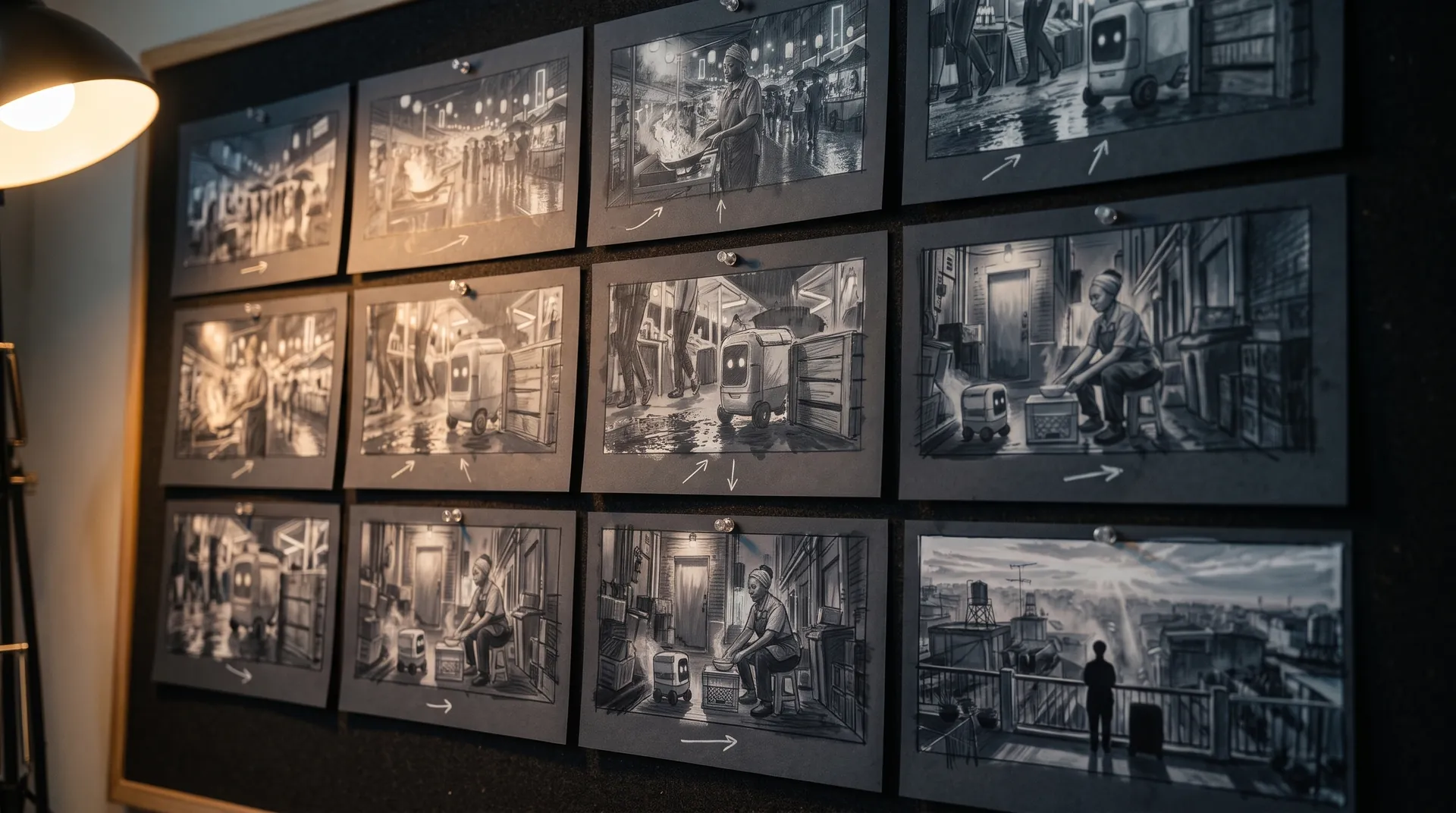
Board a storyboard
A panel for every shot, as AI stills or quick vector frames. Export it as a pitch deck.

Make motion
Titles, explainers and moving storyboards, drawn as vector animation by the AI you pick.

Characters, places, products
One subject in many versions, or new ideas for it. Every angle, look and light.
Your first film is one sentence away.
Free to start. Pay only for what you render.