What Does a 20-Minute AI Film Cost? A Worked Budget
AI long film cost, worked out: a 20-minute film takes about 5,900 to 22,700 credits on Hyperdream at two renders a shot. The budget, plans and packs.
By Divy Brahmbhatt7 min read
A 20-minute AI film costs about 5,900 to 22,700 credits on Hyperdream, depending on the video model, if each shot takes two renders to get right. At list prices on 10 November 2026, the plans and packs that cover that come to about $317 to $1,224. The spread is almost all in two numbers: the model's credits per second and how many takes you throw away.
Key takeaways
- The size of the job: 20 minutes is 1,200 finished seconds, or about 200 shots at 6 seconds each.
- Lean, standard, premium: 5,900, 13,100 and 22,700 credits, on models at 2, 5 and 9 credits a second.
- Per finished minute: 295 to 1,135 credits. Three real films ran at about 500, 815 and 1,175.
- The re-roll rate is the lever. At 1.8 renders a shot the standard film is 11,900 credits. At 2.3 it is 14,900.
- The largest credit pack is 3,500 for $199. A film has no length limit, because it is many clips cut together.
What goes into the budget?
The same formula as any AI film:
Finished seconds × credits per second × renders per finished shot, plus stills, sheets, voice and music.
| Assumption | Value | Source |
|---|---|---|
| Running time | 1,200 seconds | 20 minutes |
| Average shot | 6 seconds, so 200 shots | Our assumption. Shorter shots change the count, not the seconds |
| Renders per finished shot | 2.0 | Between the 1.8 and 2.3 measured on two real films |
| Stills and reference sheets | 1,000 credits | 5 a shot. A real 22-shot film spent 106 credits on images |
| Narration | About 54 credits | Roughly 18,000 characters at 3 credits per 1,000 |
| Music | About 42 credits | Seven 3-minute Stable Audio 2.5 tracks at 6 credits |
Stills, sheets and sound come to about 1,100 credits. Everything else is video.
What does it cost at three quality levels?
The levels are price tiers of video model, each at its default size (checked 10 November 2026). A dearer model is not better for every shot, so read "premium" as "the dearest route", not as a score.
| Level | Video model | Credits a second | Video (1,200 s × rate × 2) | Stills, sheets, sound | Total | Per finished minute |
|---|---|---|---|---|---|---|
| Lean | MiniMax H3 | 2 | 4,800 | 1,100 | 5,900 | 295 |
| Standard | Kling 4.0, Wan 3.0 or FLUX 3 Max | 5 | 12,000 | 1,100 | 13,100 | 655 |
| Premium | Seedance 2.0 | 9 | 21,600 | 1,100 | 22,700 | 1,135 |
A real film mixes models. Say 60% of the seconds on MiniMax H3, 30% on Gemini Omni 1.2 at 3 credits a second for the shots where people speak, and 10% on a 5-credit model for action. That averages 2.6 credits a second: 6,240 credits of video and 7,340 in all.
These are default sizes. Bigger ones cost more: on Gemini Omni 1.2, a 10-second clip cost 24 credits at 720p and 72 at 4K in our records.
How does that compare with real films?
We have not made a 20-minute film. The longest in our records runs 144 seconds. So here are three real client films, scaled up by their measured credits per finished second.
| Film | Credits per finished second | Scaled to 1,200 seconds |
|---|---|---|
| Industrial film, 22 shots | 8.3 | 9,960 |
| Mantra video, 9 shots, mostly 4K | 13.6 | 16,320 |
| Diwali ad, 8 shots, drafts then 4K | 19.6 | 23,520 |
None is as low as the lean level. They used dearer models and bigger sizes than it does, and the ad comes out just above the premium level. The films are in the cost of an approved AI film.
What does that come to in dollars?
Director, the film agent, needs Pro ($99 a month, 2,000 credits) or Business ($199, 4,000). Credit packs top up an active plan: 150 for $9, 500 for $30, 1,350 for $79 and 3,500 for $199.
| Level | Credits needed | One way to buy them | List price | Per finished minute |
|---|---|---|---|---|
| Lean | 5,900 | 1 month of Business, plus packs of 1,350, 500 and 150 | $317 | About $16 |
| Standard | 13,100 | 2 months of Business, plus packs of 3,500, 1,350 and 500 | $706 | About $35 |
| Premium | 22,700 | 3 months of Business, plus three 3,500 packs and a 500 pack | $1,224 | About $61 |
Prices are US dollars, read from /pricing on 10 November 2026. Taxes may apply. Three rules matter on a long job:
- Plan credits last 2 months. What you don't use carries into the next month, then ends.
- Pack credits last 1 year. Buy them when you need them, not before.
- A failed or blocked render refunds automatically. The budget above counts takes that finish.
All the plan rules are in Hyperdream pricing explained.
How much does the re-roll rate change it?
More than the choice of plan. Here is the standard level again at four rates.
| Renders per finished shot | Where the rate comes from | Video credits | Total |
|---|---|---|---|
| 1.8 | Industrial film, part 2 | 10,800 | 11,900 |
| 2.0 | This budget | 12,000 | 13,100 |
| 2.3 | Industrial film, part 1 | 13,800 | 14,900 |
| 4.4 | Diwali ad's count, if every take were full price | 26,400 | 27,500 |
The last row is a warning, not what that ad cost. Most of its extra takes were 720p drafts at a third of the final's price. Drafting small is one of the seven ways to need fewer takes.
Is raw model access cheaper?
Per second, often yes, and we would rather say so. When we asked ChatGPT on 10 November 2026 for the cheapest way to make a film of 20 minutes or more, it answered with video models and their price per second.
That price is for one clean take. For this film you would render about 2,400 seconds to keep 1,200, and make around 200 stills, the reference sheets, the narration and the music. Then someone has to carry the right references into each of 400 renders and track which take was approved.
If you have a pipeline for that, raw access can come out cheaper. If you don't, count the discarded takes and your hours before you compare. We did not price this film on any other platform. The per-second prices of the ten models are ranked in AI video cost per second.
What is the cheapest way to make a long AI film?
- Use the 2-credit model wherever it holds. MiniMax H3 is open on every plan. Keep dearer models for the shots that need them.
- Approve every shot as a still first. A still costs 1 to 5 credits. A 6-second video take costs 12 to 54.
- Hold the re-roll rate near two. One reference sheet per character, one action per shot.
- Let narration carry it. Twenty minutes of narration is about 54 credits of voice.
- Make one minute first. Measure your own renders per shot on a 10-shot pilot, then multiply.
What does this budget leave out?
- Your time. The 22-shot film logged 5.5 to 6.2 hours of work in the app, about a quarter of an hour a shot. At that pace 200 shots is roughly 50 to 56 hours. That is an extrapolation, not a measurement.
- The export of a film this long. The Edit step makes one MP4 at up to 1080p in your browser, and the tab has to stay open. We have not exported a 20-minute film this way. None of the films in our records was exported from the Edit step. Where a cut exists, it was made in an outside editor.
- Songs. Audio One songs are for personal use only on every plan, so this budget uses instrumental music.
How do you set this up in Hyperdream?
- Open Director on Pro or Business and paste the script into Script.
- In Look, set render quality to Draft (720p).
- Make one reference sheet per character in Cast and per location in Places.
- Approve the Storyboard stills scene by scene.
- In Shots, set the model per shot. Three render at a time, and each shows its price first.
How we checked
Model prices, plans and packs were read from Hyperdream's live model list and /pricing on 10 November 2026. Staff can change them, so check before you budget. Credits per finished second and render rates are from the project records of films made on Hyperdream in 2026. Everything else is our arithmetic: the 6-second average shot, the 2.0 re-roll rate, 5 credits of images a shot, the narration length and the working hours are assumptions, not measurements. We have not made or exported a 20-minute film on Hyperdream, and we did not price one on raw model access or on another platform.
Questions people ask
On Hyperdream, about 5,900 to 22,700 credits at two video renders per finished shot, depending on the video model. At list prices on 10 November 2026, the plans and packs that cover that cost about $317 to $1,224.
Keep reading

Guides19 November 20267 min read
How AI Video Credits Work: Rollover, Packs and Refunds
AI video credits explained: what a credit buys, how long it lasts, which tools roll credits over, how packs work and what comes back when a render fails.
Guides15 November 20266 min read
Re-Rolls Burn Credits: 7 Ways to Need Fewer Takes
Seven ways to reduce AI video credit usage: approve stills first, lock reference sheets, draft at 720p and finish once. With what each saved on real films.

Guides10 November 20269 min read
The Cost of an Approved AI Film, Not a Clip (2026 Numbers)
AI film cost is finished seconds times credits per second times renders per shot, plus stills, voice and music. Three client films used 941 to 1,289 credits.
More than images and video
Scripts, storyboards, motion, and characters in every version. Each one on its own, or all of them in a film.
Write a script
An idea in, a properly formatted screenplay out. Edit any line, then board it or film it.
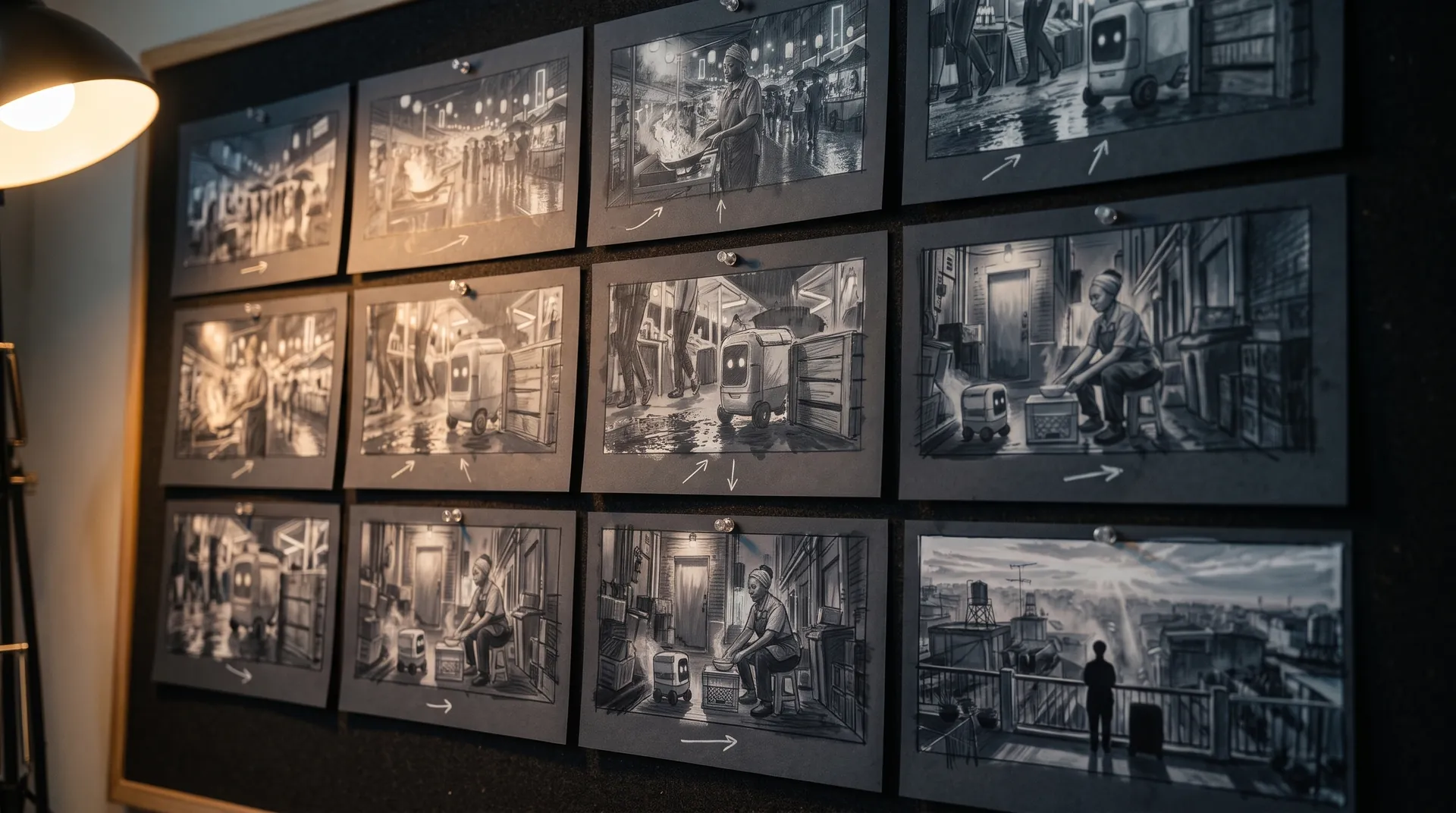
Board a storyboard
A panel for every shot, as AI stills or quick vector frames. Export it as a pitch deck.

Make motion
Titles, explainers and moving storyboards, drawn as vector animation by the AI you pick.

Characters, places, products
One subject in many versions, or new ideas for it. Every angle, look and light.
Your first film is one sentence away.
Free to start. Pay only for what you render.